
The link between mental health and Huntington’s disease
Each September, Australia recognises R U OK? Day, dedicated to acknowledging mental health and checking in on the people we know. Huntington’s Australia would also like to use this day to shine a spotlight on the relationship between Huntington’s disease (HD) and mental health.
In this article, we explore mental health and how it relates to Huntington’s disease, including possible symptoms it can cause. Impacting everyone from individuals living with HD to their friends, families, and carers, R U OK? Day is a reminder that it’s always a good day to check in on the people you know and love.
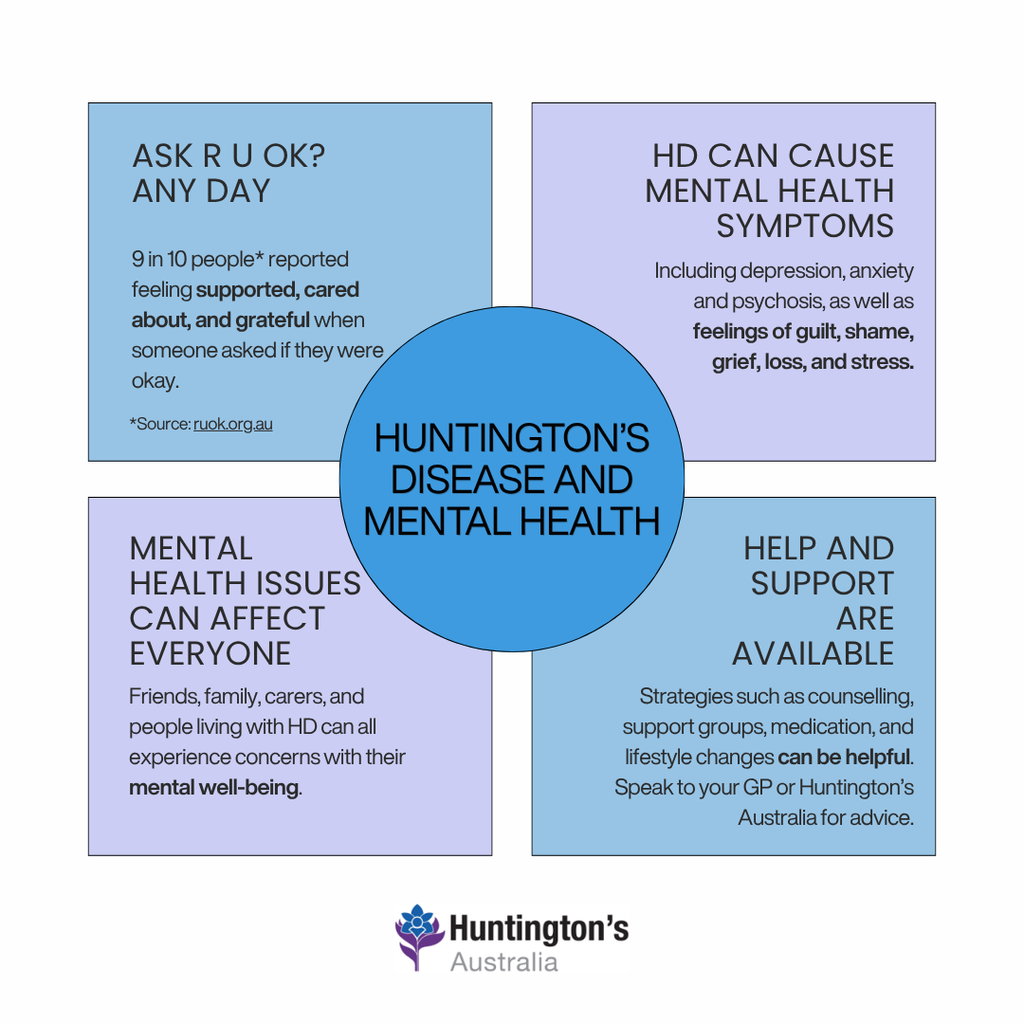
How does Huntington’s disease impact mental health?
Huntington’s disease is a neurodegenerative disease that causes nerve cells in the brain to decay over time. Along with physical symptoms, HD can also cause emotional, behavioural, and cognitive changes that impact a person’s mental health, including:
- Feeling irritable, sad, or anxious
- Changes in personality
- Impulsiveness
- Lack of motivation or drive
- Problems concentrating, planning, organising, and thinking clearly
- Fixation on certain ideas, feelings, speech, or thoughts (also known as perseveration)
- Thoughts of suicide, depression, or loss of contact with reality (also known as psychosis)
Everyone experiences HD differently, and symptoms can vary greatly between individuals. They can also change over time. In addition to the clinically recognised symptoms of HD, the condition itself can also lead to thoughts, emotions, and experiences that might also affect mental wellbeing.
Other ways HD can affect mental wellbeing
Someone living with Huntington’s disease may feel concern about their future, worry that their needs are a burden on their family, or feel angry about their diagnosis. HD can also be especially isolating, with some people feeling as if they want to pull away from everyone they know.
Huntington’s disease can also impact the mental health of family members, friends, and carers. They may experience feelings of guilt, grief, worry, hopelessness, and stress, stemming from seeing their loved one’s symptoms progress, undergoing genetic testing, and uncertainty about the future.
What’s most important to know is that there is no right or wrong way for someone to feel – they are all valid and unique to the individual. It’s equally important to check in with the people we know and love, so they know support is available.
Where can you seek help for mental health?
It’s not always easy to ask for help with your mental wellbeing. Some people prefer not to share their thoughts and feelings with others, and others might not even be aware of a change. If you do notice someone seems to be struggling, you can ask how they’re doing and acknowledge that you’re there to listen.
If they need further help, speaking to a GP or a trusted healthcare practitioner can be beneficial. They may offer strategies to improve mental wellbeing, including referrals to mental health practitioners, medication, and lifestyle changes, all tailored to the individual.
There are many ways to manage mental health, and a combination of different strategies could be the best approach. What’s most important is finding solutions that work best for you.
R U OK? Day is Any Day
This R U OK? Day, we’re reminded to check in with the people we know and love, and with ourselves. Although Huntington’s disease can impact mental health, it’s not a burden anyone should carry alone. Reach out to Huntington’s Australia for support here or on 1800 244 735.
If you or someone you know needs help, free support is available by contacting:
Lifeline on 13 11 14 (24/7 crisis support service)
Beyond Blue on 1300 22 46 36 (counselling service)
Kids Helpline on 1800 55 1800 (24/7 national online and phone counselling for young people aged 5 to 25 years)